
Advanced Astronomy
Requires Grades 9-12th Level Membership
A College Level Science Course for Advanced High School Students
This is a fun, inspiring, and academically challenging astronomy course created especially for advanced homeschoolers who are ready for something beyond the usual science class. It’s the kind of course you’d find in college, designed by astronomers to be exciting, hands-on, and accessible for teens.
Real Astronomy for Teens
Students will explore space, planets, moons, stars, and more through interactive labs, stargazing, real science projects, and weekly assignments that spark curiosity and build confidence. Whether your student dreams of becoming a scientist or just loves looking at the night sky, this course is designed to ignite their passion for space and help them think like a real astronomer. (Parents are welcome to do this course with your student.)
Self-Paced Classes
This course is fully self-paced and can be completed on your own schedule. All lessons and materials are available asynchronously, giving students the flexibility to progress through the course at a pace that fits their learning style and availability.
Science Lessons & Lab Classes
This is a BIG course. Expect to spend at least one hour every day outside of class time working through the reading, homework, and lab project assignments. Click the buttons below to download the course materials and read these over carefully. Then gather your binder and materials together so you can feel great about being organized and ready for each new week.
Part 2: Key Astronomy Concepts
Part 3: Learning from Other Worlds
Going Further
Thank you for completing the first set of 12 lessons for the Advanced Astronomy course! We're planning to release the second set of 12 lessons in the future.
In the meantime, you have two choices for continuing your studies.
First, if this course felt too deep and fast, students are encouraged to continue with the regular astronomy program that can be accessed here. It covers astronomy at a somewhat slower pace, yet still includes essential topics and lots of hands-on activities.
If the course felt comfortable, and you were able to complete all lessons and assignments, I encourage you to look into Boyce Astro https://boyce-astro.org, a well-established nonprofit organization that offers authentic research opportunities, mentoring, and observational astronomy programs for motivated students. Many of their student research and mentoring opportunities are offered at no cost or very low cost, depending on the program. Their offerings align well with what we have done so far and provide a meaningful next step for students who are ready to pursue astronomy more independently.
Capstone Projects
During the course, we'll be starting to dive into deeper Discovery labs which can lead to more extensive study, including:
- Asteroid Photometry (Discovery Lab #2)
- Radio JOVE Astronomy (Discovery Lab #3)
- Seestar Spectroscopy (Requires Seestar S30 or S50, find instructional videos at link here and the spectroscopy community here. Dr. Yung is a prominent figure in the amateur astronomy community known especially for stellar spectroscopy education to help students engage in real science education.
- Speckle Interferometry at Mt Wilson (info here) with Dr. Russ Genet. Dr. Genet is an astronomer and professor who specializes in photometric observations and very short-period eclipsing binary stars, and has helped thousands of students publish over 700 astronomy research papers. Example Research paper
Meet the Teacher
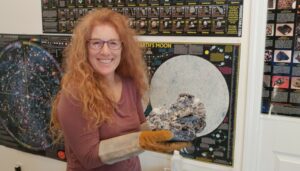
Aurora Lipper is an astronomer, mechanical engineer, and science educator with over 25 years of teaching experience. She holds a Master’s degree in Mechanical Engineering with a focus on gas dynamics and complex fluid flow for high performance jet engines. Aurora has taught engineering courses at the university level and currently serves as a guest lecturer for local high schools and Cal Poly.
She is the founder of Supercharged Science, an award-winning STEM curriculum used by thousands of homeschool families and charter schools. Aurora is also the president of the Central Coast Astronomy Society, where she leads public star parties, telescope demonstrations, and community science outreach.
Aurora is the author of Astronomy Activities for Kids (Penguin Random House, 2021), a bestselling book with over 1,000 five-star reviews. She brings her passion for space, teaching, and hands-on learning into every lesson to spark curiosity and confidence in her students.
Prerequisites
This is a college-level introductory astronomy course adapted for advanced high schoolers. Students are not expected to have prior experience in astronomy, but they should meet the following prerequisites to ensure success:
- Math Proficiency: This course requires completion of Algebra 1. Students should be comfortable with solving basic equations (3x +1 = 10 ), working with scientific notation (17,500 = 17.5 x 10³), ratios (like miles per hour), operations on powers of ten, and it’s helpful to be familiar with simple graphs. Full details on page 7 of the Info Packet (link above).
- Reading & Comprehension Skills: Students should be able to read and understand nonfiction texts at a high school or college level, as the course includes physics concepts presented through detailed readings, diagrams, and data visualizations. Textbook reading is essential for this course.
- Independent Study Habits: Students are expected to manage weekly reading assignments, complete labs and projects independently, and engage in self-directed learning between lessons.
- Curiosity and Commitment: A love of science and a willingness to ask big questions is essential! Students will explore not just facts, but the process of science, including how we know what we know about the universe. All students with an interest in space or the natural sciences will find themselves right at home.
Course Format
This course offers self-paced lessons one per week and blends college-level content with an engaging, hands-on learning experience designed specifically for advanced high schoolers.
Each lesson includes:
- Recorded Teacher Lesson: Students are expected to prepare by reading the assigned material before starting the teacher lessonvideo.
- Weekly Assignments: Between lessons, students will complete reading assignments, short-answer homework questions, and weekly review quizzes to reinforce key concepts. Most homework is focused on understanding and applying big ideas, not busywork.
- Lab Activities & Projects: Labs are designed to be fun, hands-on, and inquiry-based. Some labs are completed during the video lesson, while others are started after the lesson and finished at home. Projects include long-term investigations, creative presentations, and real astronomical observations.
- Podcast Passport Journals: Each week, students will listen to a space-related podcast of their choice and write a short reflection. This encourages students to explore current science topics and make personal connections with the material.
- Astronomer Spotlight Presentations: Students will research and present a short report on an influential astronomer, helping them learn to communicate science and appreciate the human side of discovery.
- Optional Stargazing Events: Students are invited to attend monthly stargazing nights hosted by their local astronomical astronomy club, or participate in the online stargazing sessions hosted by the Central Coast Astronomy Society. These events offer telescope access, sky tours, and real-world application of course content.
This flexible yet structured format is designed to build deep understanding while allowing room for creativity, curiosity, and student-led exploration.