
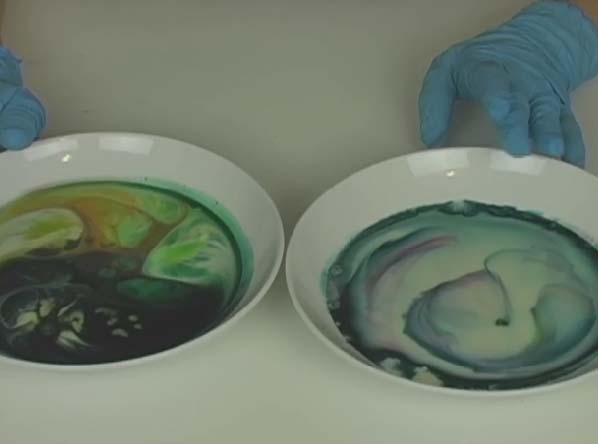
 Have you ever tried washing dishes without soap? It doesn’t work well, especially if there’s a lot of grease, fat, or oil on the dish!
The oils and fats are slippery and repel water, which makes them a great choice for lubration of bearing and wheels, but lousy for cleaning up after dinner.
So what’s inside soap that makes it clean off the dish? The soap molecule looks a lot like a snake, with a head and a tail. The long tail loves oil (hydrophobic) and the head loves water (hydrophilic). The hydrophilic end dissolves in water and the hydrophobic end wraps itself around fat and oil in the dirty water, cleaning it off your dishes.
Let’s do an experiment that will really make you appreciate soap and fat:
Please login or register to read the rest of this content.
Yes! The Cool Milk Trick is a great example of how surfactants work.
Dish soap contains surfactants, which are molecules that have two different ends: one that is attracted to water (hydrophilic) and another that is attracted to fats and oils (hydrophobic).
When you add dish soap to the milk, the surfactants lower the milk’s surface tension and interact with the fat molecules. This causes movement in the milk, carrying the food coloring along with it and creating those beautiful swirling patterns.
The food coloring helps you see the movement, but it isn’t actually reacting with the soap.
So yes, this experiment demonstrates surfactant action, especially how soap changes surface tension and interacts with fats and oils.
Is this a example of surficant?
IU haven’t tried it yet – please tell me what you find out!
Could you use dairy free milk like almond milk or oat milk?
Any type of food coloring should work.
Dose gel food coloring work too?